
“The world is easier and more comfortable when we can solve new problems with solutions that we have used previously”. J. Scott Armstrong, Long Range Forecasting, From Crystal Ball to Computer
The Coronavirus pandemic is a traumatic event with unforeseen and lasting consequences, some or many of them yet to be known. The virus was detected at the end of 2019 in China and then expanded rapidly across the globe causing thousands of deaths. Governments have been undertaking containment measures but this led to a sudden and sharp drop in the economic activity.
From now on and until a cure is found, all business initiatives and the consumer behavior will be driven, in cases determined, by the Government Response to the pandemic. The resulting level of activity will be depend on:
- the evolution of COVID cases identified and mortality rates.
- the nature and intensity or stringency of lockdown and reopening of each activity
- the effectiveness of fiscal and monetary measures to restore offer and demand sides of the business.
In this uncertain context , 3 frameworks were identified to restore the business, prioritize activities and reduce the risk of the pandemic.
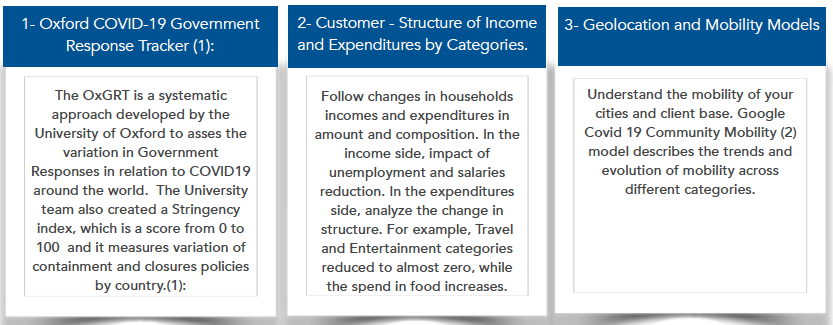

The deployment of these models combined with relevant business financial data anticipates the impact of lockdown and reopening increasing, at the same time, the ability to restore the business in safe and efficient manner, easing the burden of the crisis for stakeholders.
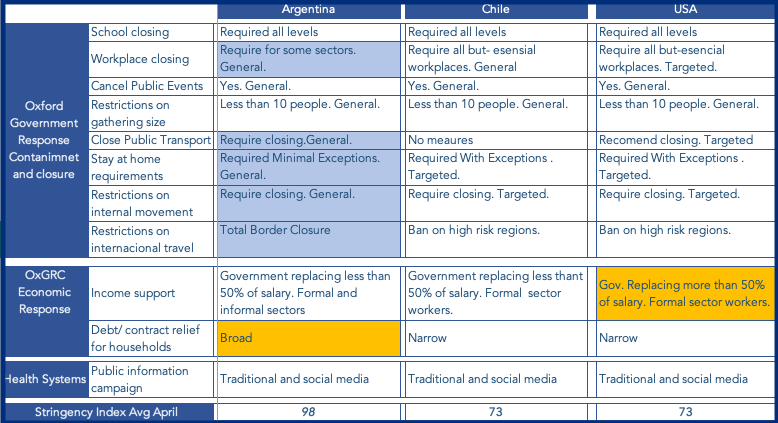
A Case Study is shown below with a comparison and outcomes of Argentina, Chile and USA in April 2020. For further details in another Countries, Industries and you contact us via the page in the Contact Us section or write to hgm@hgmconsulting.cl
(1) Hale, Thomas, Noam Angrist, Beatriz Kira, Anna Petherick, Tobyhillips, Samuel Webster. “Variation in Government Responses to COVID-19” Version 5.0. Blavatnik School of Government Working Paper. April 24, 2020.
(2) Google LLC “Google COVID-19 Community Mobility Reports”. https//google.com/covid19/mobility
CASE STUDY – Modeling the Response of Argentina, Chile and USA in April 2020
Highlights
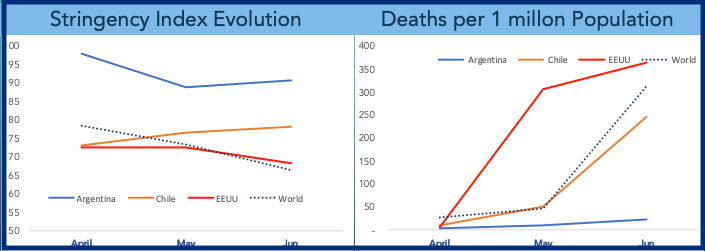
- In terms of Containment, Argentina presents the highest level when compares against Chile and USA. This is also reflected in the Stringency Index.
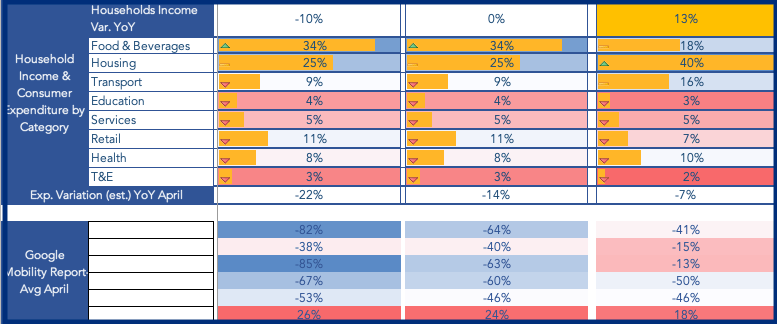
- Likewise, Argentina is the worst performer in economic terms. Measures taken in USA regarding income support throughout Unemployment Insurance have a positive effect sustaining the level of spend.
- Significant changes in Households expenditure with impact in the structural size of markets. Increase in Ecommerce sales with exception of Travel category.
- Containment measures mirrored by the Mobility categories, higher stringency leads to lower mobility with diverse impact across industry sectors.
- Numbers of COVID cases and deaths are lower in Argentina anticipating a relaxation of country’s stringency and opportunities to restore business.
 HGM Consulting